
Choi Yeon's Tuna Love: Premium Tuna Restaurant Review
Tuna is often called the Porsche of the ocean.
I am a person who has fallen deeply for that singular fish.
There are times when life gets busy and the wallet feels light, leading to a resolve to skip my weekly ritual.
But that resolve rarely lasts a month. The memory of the taste is too vivid to ignore, and eventually, my feet find their way back to the restaurant.
No matter how tired I am, even if I am half-asleep, a friend's invitation to go for tuna will have me out the door in an instant.
This is my story.
I love tuna beyond measure.
It is perhaps more accurate to call it a form of reverence.
It is no exaggeration to say I opened this restaurant simply because of this love.
Among the many paths in the culinary world, I would never have dreamed of any other business.
For me, there was only one choice. It had to be tuna.
Today, I would like to share the story of this remarkable fish.
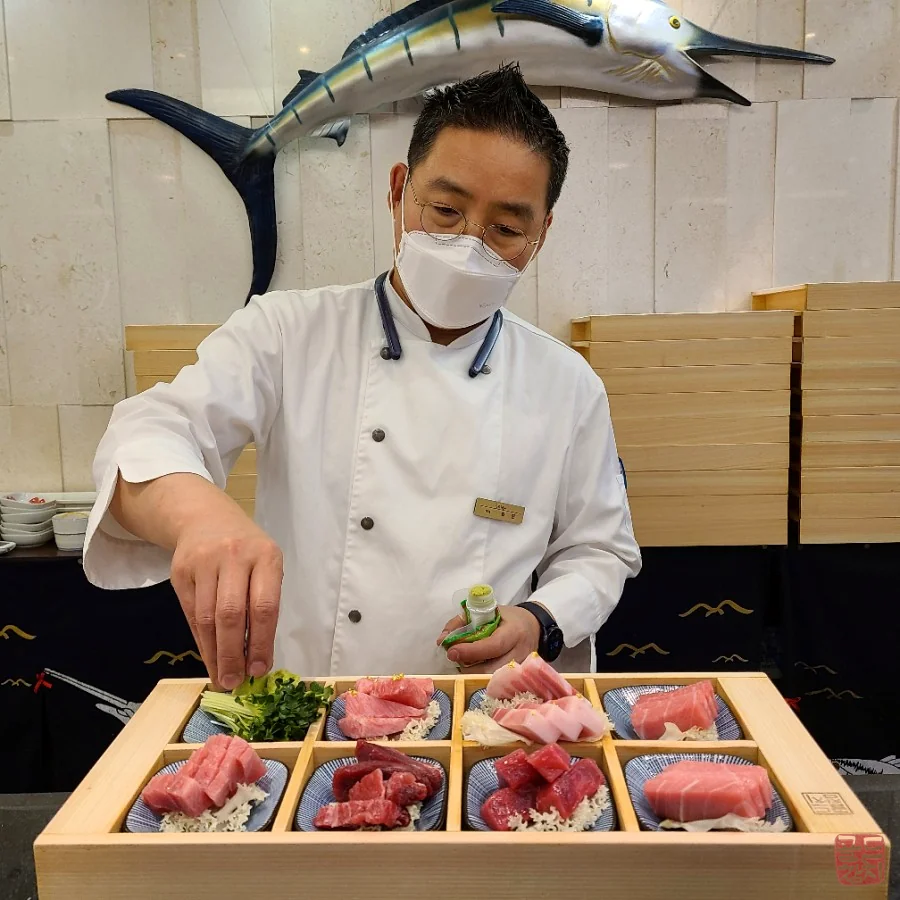
While most simply say tuna, we use specific names to distinguish the many varieties.
Classification is essential because each species offers a distinct experience.
Rather than using vague terms, we categorize them clearly: Bluefin, Bigeye, Yellowfin, Albacore, and Skipjack. Each name carries its own weight and identity.
Beyond nutrition, the first thing one notices is the sheer flavor. As a member of the mackerel family, it possesses a deep crimson hue and is renowned for its benefits to brain health. To the palate, it offers a fatty, rich depth that few other meats can match. This "umami" comes from inosinic acid, a natural component that defines savory richness. It is so potent that it can be quite addictive; those with a weak will should approach with caution.
While I am not a nutritionist, I can speak from the perspective of the kitchen. There is a notable difference in the oils. In our prep area, we are constantly handling the fish, yet our drains never clog with solidified fat. This is the hallmark of unsaturated fatty acids—fats that remain fluid and are beneficial to the body. If our blood vessels are like the plumbing of the body, then the clean nature of tuna fat is a comforting thought.
Specialty restaurants generally focus on Bluefin, Bigeye, and Yellowfin. You may also encounter Swordfish, known for its pale flesh and red speckles. While its creamy texture is often a favorite for beginners, it does not strictly fall within the tuna family. In many casual establishments, Swordfish and Yellowfin are the primary offerings.
At my restaurant, we curate our selection strictly: the bellies of Bluefin, Southern Bluefin, and Bigeye. Southern Bluefin is a prized catch from the warmer waters of the southern hemisphere; though smaller than the standard Bluefin, its texture and aroma place it firmly in the luxury category.
The price variations in a tuna specialty shop can be significant. This is a direct reflection of the species and the specific cut being served. For instance, Bluefin can be more than three times more expensive than Bigeye by weight.
Even within the same Bluefin tuna, prices can vary fivefold depending on the part. These wholesale realities are what shape our menu.
The prized belly meat accounts for only about 25% of the entire fish. This excludes the collar, the back, and the head, tail, and organs. I would also like to clarify the "navel" cut often mentioned. In truth, it is not a navel—as fish do not have them—but rather the point where the circulatory and lymphatic systems meet. It is called the navel because, when sliced vertically, its appearance strikingly resembles one.
The belly is graded starting from the collar (the most prized neck-belly) and numbered through segments one to five. Naturally, the forward segments are more luxurious and costly, with the value decreasing by about 20% with each subsequent segment.
The collar-belly, or Kamatoro, is the pinnacle. Its vibrant pink marbling is a sight that immediately stirs the appetite. However, its scarcity makes it exceptionally rare and high-valued.
Next is segment one, the standard for top-tier establishments. While the collar-belly is purely rich, segment one offers a perfect balance of protein and fat, providing a complex savoriness that true connoisseurs prefer. In my kitchen, we utilize the collar, segment one, and segment four, tailoring each to the specific needs of our courses.
We also place great emphasis on Southern Bluefin. As a species that is not farmed, it must be caught in the wild. This results in a texture and aroma that often surpasses farmed Bluefin. However, because it is wild, the quality varies by season and region, and it is prone to rapid browning if not managed with extreme care. It is a temperamental fish to work with.
Finally, there is the Bigeye. This is the staple of most specialty shops. I specifically source the belly cuts, which professionals call "bok-yuk." I am particularly meticulous about this cut, often pre-purchasing the highest grade stock to ensure our quality remains consistent.
When discussing tuna, one cannot overlook the art of tempering.
This is perhaps the most critical factor in the guest's experience. Tempering is not merely thawing ice; it is a comprehensive process of removing deep cold, precision cutting, and resting. It is the journey of bringing the fish from -50 degrees to the perfect state for consumption.
I focus on three non-negotiable principles: full tempering, precise thickness, and moisture control. Freshness, of course, is the baseline for everything.
We insist on full tempering to protect the flavor. The palate cannot truly distinguish taste when it is numbed by cold. Cold is a sensation of pain, not flavor. True taste reveals itself only when the taste buds are at ease. Therefore, we never serve tuna that still holds ice or deep cold. On the rare occasion a guest asks for it "chilled," I politely explain our philosophy and suggest they might be happier elsewhere.
Second is thickness. It must be substantial without being unwieldy. The goal is to enhance the mouthfeel. Just as meat is often more satisfying when it requires a firm bite, the texture of the tuna provides an additional layer of flavor. This texture can only be achieved when the fish is fully tempered.
Finally, there is moisture control. I often tell my kitchen staff that food must be beautiful. If it isn't beautiful, it cannot truly be delicious. No one wants to reach for a piece of fish sitting in a pool of water. Moisture management is another reason for full tempering; if any cold remains in the core, condensation will form, creating a distracting sheen on the surface. I find such a presentation unacceptable.
This entire preparation takes at least two hours for every piece we serve. The process of tempering, drying, cutting, and resting is intricate.
This is why we have adopted a reservation-based system. It allows us to predict demand and prepare each piece so it reaches our guests in its prime. When guests arrive unexpectedly in large numbers, it can be a challenge to maintain our standards without making them wait, as quality cannot be rushed.
Thankfully, our guests have embraced this system, and most now reach out to us in advance.
My love for this fish will continue unchanged.
My staff sometimes ask me, "Do you ever get tired of tuna?"
"Never," I reply. "It is the finest thing in the world. Have a piece yourself."
It is a craft, and a fish, that I truly love.
#CulinaryDevotion
#BangiDistrict
#Goldtuna
#TheTunaSanctuary