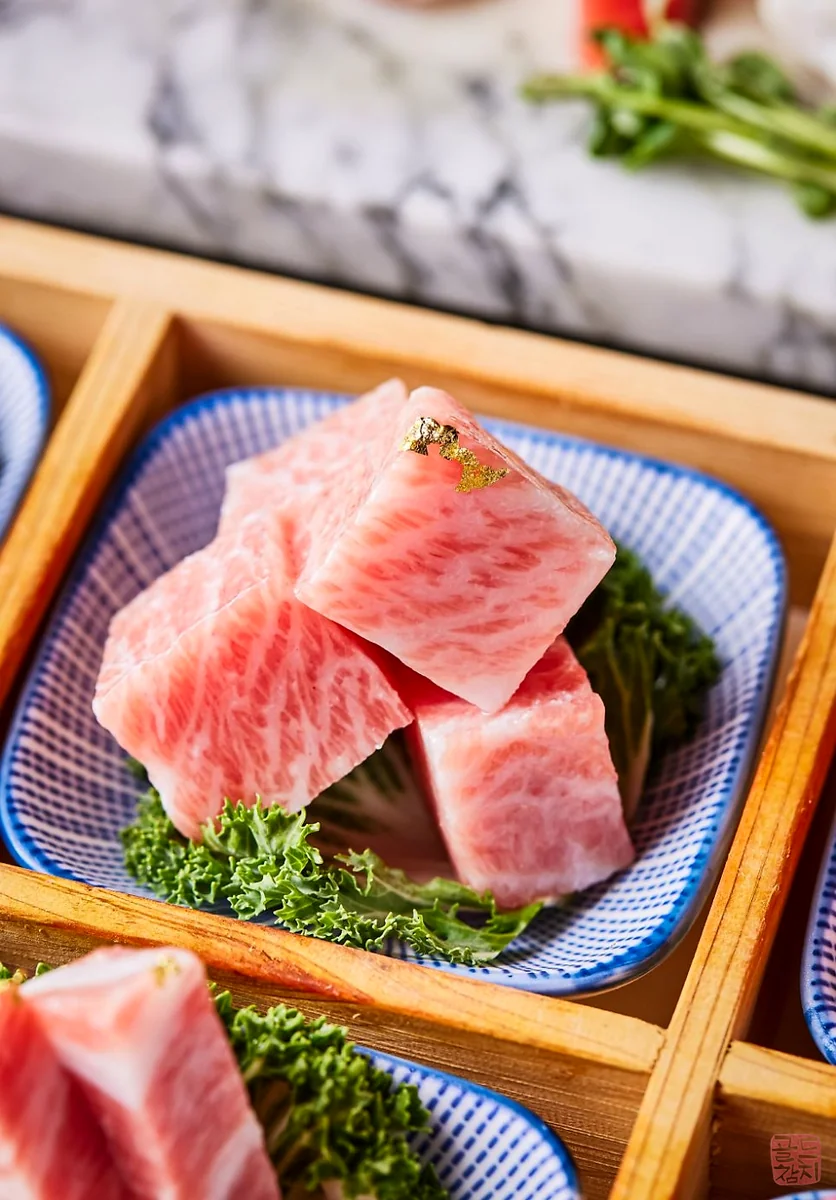
Bluefin Tuna vs. Hanwoo Beef: Price Analysis by Cut
Recorded and Verified by: Mr. Tuna | Goldtuna
We often cite Hanwoo (Korean beef) as the synonym for noble ingredients. I suddenly became curious: where does the value of Bluefin tuna, a precious guest of the sea, stand in comparison?
Together with the Goldtuna family, I compared the value of raw tuna with Hanwoo. When looking at the same weight, the primary belly cuts of Bluefin tuna held a precious value that was by no means inferior to Hanwoo sirloin or striploin, and the collar meat (gamasal) required a completely different calculation altogether.
Of course, I established clear criteria for a transparent comparison. Goldtuna's tuna prices were based on actual business purchase prices, and Hanwoo prices were based on the average factory release price of Grade 1 castrated beef announced by the Korea Meat Trade Association, rather than retail prices.
This was to look into the value of the raw material itself rather than a simple retail price comparison. Currently, Grade 1 Hanwoo tenderloin is priced at 93,250 KRW per kg, striploin at 70,575 KRW, and sirloin at 61,575 KRW.
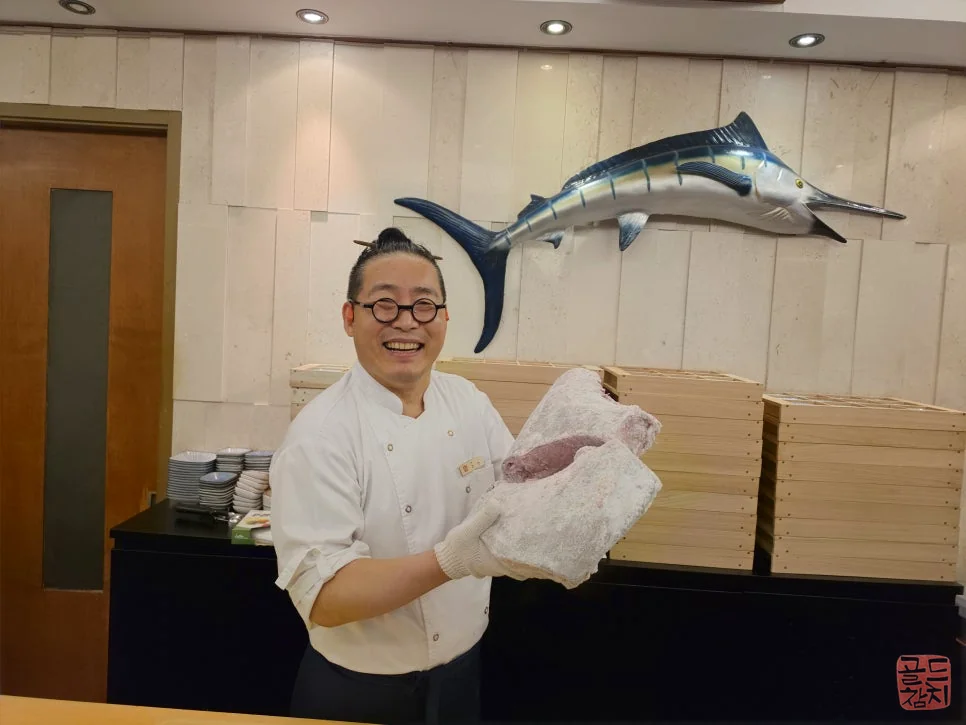
This is the appearance of the raw farmed Bluefin tuna collar (gama) at Goldtuna. The collar meat (gamasal) is finally born from between these rough bones.
1. You shouldn't look at the raw material price alone for Bluefin tuna collar meat
Goldtuna's purchase price for the raw collar material in the photo is approximately 40,000 KRW/kg.
Looking at the numbers alone, it might seem more reasonable than the belly cuts. However, this raw material cannot be served entirely on the table.
The collar contains massive bones. After Goldtuna's strict trimming, the actual collar meat used for sashimi is only about 30%. Slight differences in yield occur depending on the condition of the raw material and the artisan's touch.
The calculation to obtain the essence of that 30% changes as follows:
Raw Collar Material 40,000 KRW/kg ÷ 30% Yield
= Actual usable collar meat approx. 133,000 KRW/kg
In the end, to obtain 1kg of collar meat, we willingly purchase 3.3kg of raw material. This is a conclusion reached even excluding skilled labor costs or meticulous processing expenses.
This is why, when we talk about the value of collar meat, we must distinguish between the apparent cost of the raw material and the actual cost of what melts in your mouth.
2. Even compared to Hanwoo tenderloin, the cost of collar meat is not low
I placed the weight of Grade 1 Hanwoo tenderloin, striploin, and sirloin alongside Goldtuna's tuna costs. The value of the essence of different lives can be seen at a glance.
|
Raw Material |
Price per kg |
Basis |
|
Bluefin Tuna Collar Meat (Gamasal) |
130,000 KRW |
Goldtuna Purchase Price |
|
Hanwoo Grade 1 Tenderloin |
93,250 KRW |
Factory Release Avg. |
|
Bluefin Tuna Collar Belly (Gama-toro) |
78,000 KRW |
Goldtuna Purchase Price |
|
Bluefin Tuna No. 1 Belly (Toro) |
76,000 KRW |
Goldtuna Purchase Price |
|
Bluefin Tuna No. 2 Belly (Toro) |
71,000 KRW |
Goldtuna Purchase Price |
|
Bluefin Tuna Navel Meat (Bekkopsal) |
71,000 KRW |
Goldtuna Purchase Price |
|
Hanwoo Grade 1 Striploin |
70,575 KRW |
Factory Release Avg. |
|
Hanwoo Grade 1 Sirloin |
61,575 KRW |
Factory Release Avg. |
|
Bluefin Tuna Red Meat (Akami) |
38,000 KRW |
Goldtuna Purchase Price |
|
Southern Bluefin Tuna Belly |
34,000 KRW |
Goldtuna Purchase Price |
|
Bigeye Tuna Collar Belly |
34,000 KRW |
Goldtuna Purchase Price |
* Tuna prices are based on Goldtuna purchases as of August 8, 2026, and may change according to exchange rates and supply trends. Hanwoo prices were compiled based on the Korea Meat Trade Association's average factory release price for Grade 1 steers.
As shown in the table, the value of No. 1 and No. 2 belly cuts is closely aligned with the value of Hanwoo striploin.
[Texture of Farmed Bluefin Tuna No. 1 Belly]
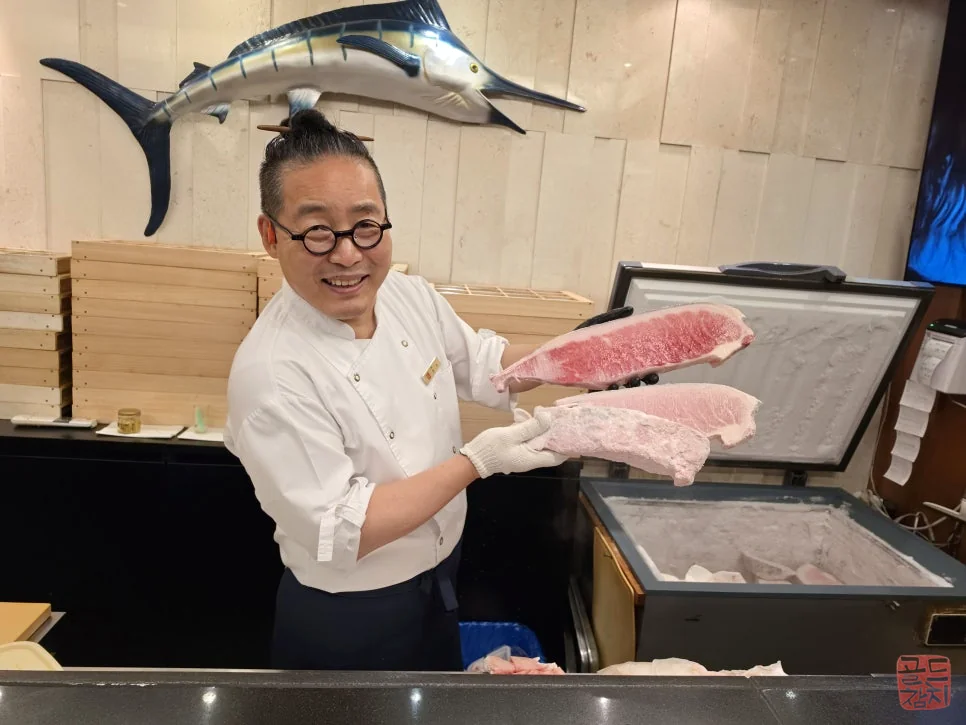
This is the farmed Bluefin tuna No. 1 belly served at Goldtuna's table.
3. Just as Hanwoo differs by cut, tuna prices vary by part
We do not judge value simply by the name 'Hanwoo.'
Just as the texture differs whether it is tenderloin, striploin, or sirloin, the market price difference between tenderloin and round steak within the same Grade 1 Hanwoo is clear.
Tuna follows the same logic.
Starting from what kind of tuna it is, to which part it was taken from—such as collar meat, navel meat, or red meat—the depth of flavor and rarity contained in each piece varies.
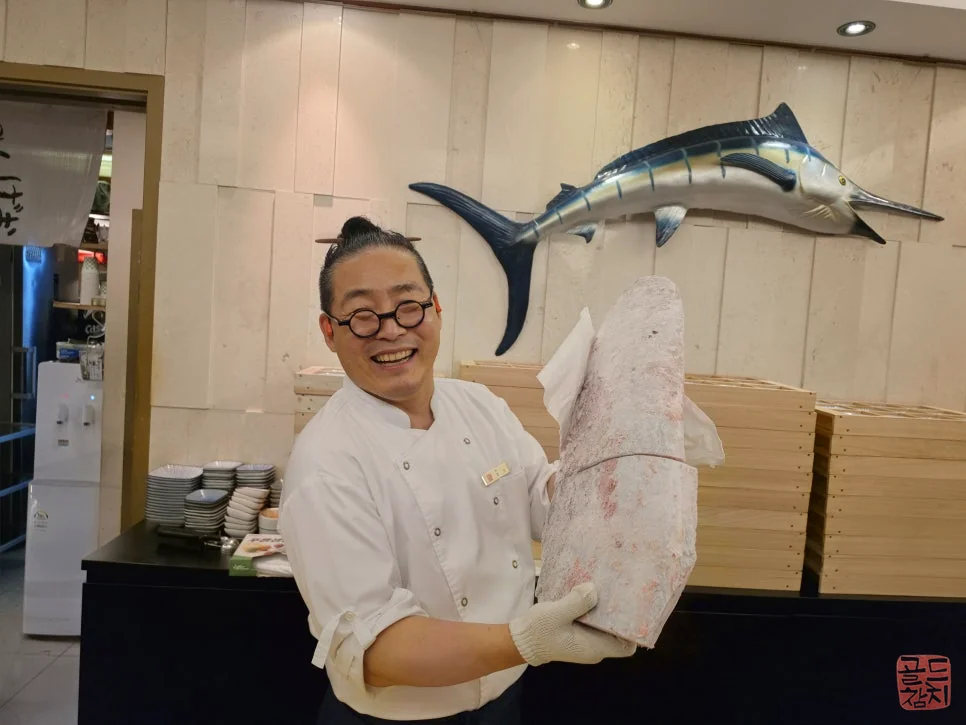
The actual appearance of Southern Bluefin tuna belly (the part containing the internal organs).
[The Stature of Bigeye Tuna]
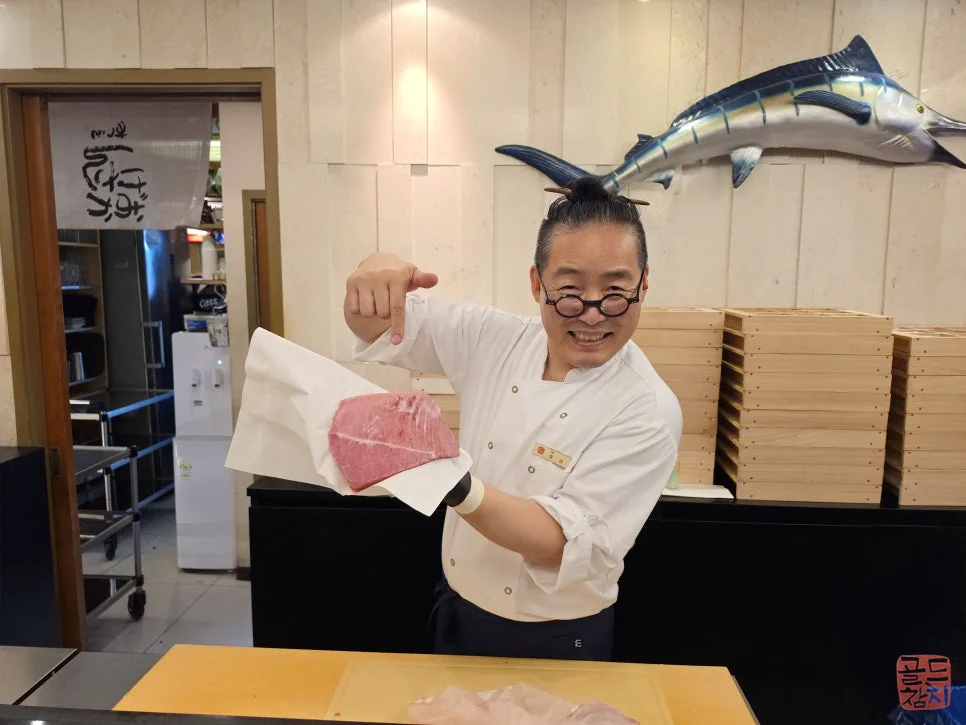
The appearance of Bigeye tuna collar belly, cut only from the front section of the Bigeye belly.
[Bluefin Tuna Navel Meat]
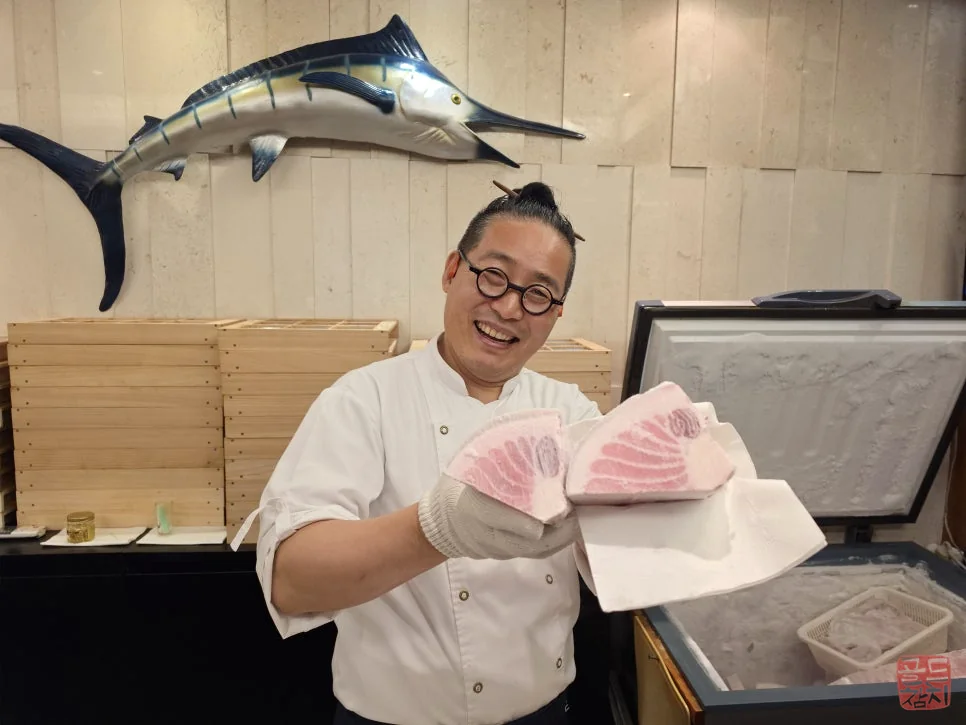
The appearance of the Bluefin tuna navel meat (bekkopsal) after being cut.
[Bluefin Tuna Red Meat · Akami]
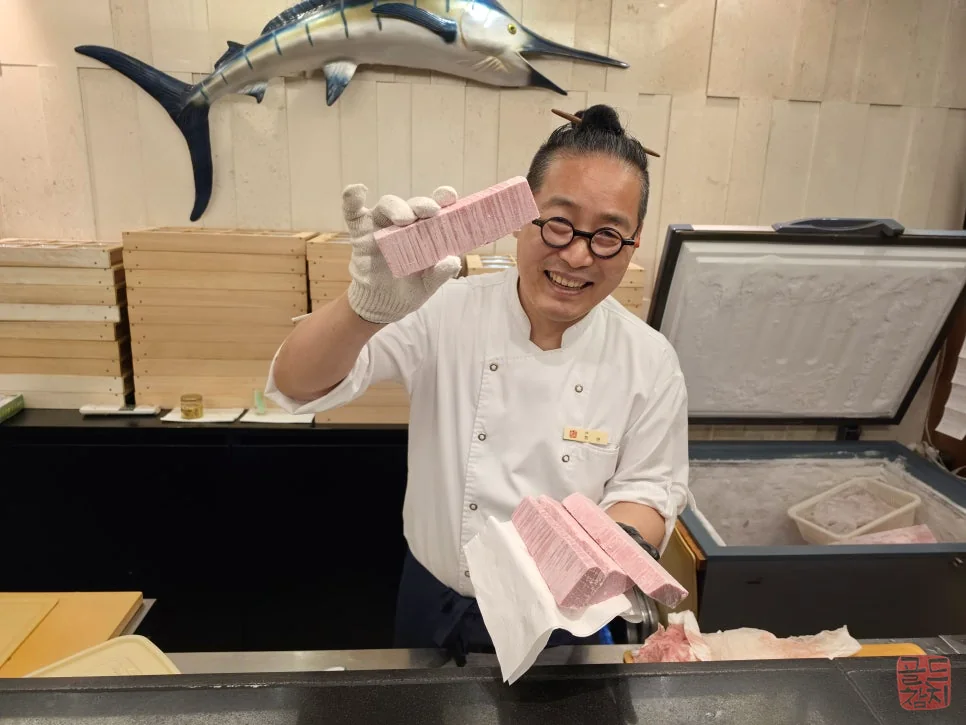
This is the lean inner meat of the Bluefin tuna, called red meat or akami. This is how it looks after removing the bloodline and cutting it into sticks.
Therefore, the single term 'Bluefin tuna' cannot capture all the true value of the raw material.
We must look deeply into what species it is, the size of the raw fish, and which precious part is being served.
4. Why collar meat is used only in the Omakase Special
I would like to address why we cannot serve collar meat (gamasal) in every course at Goldtuna. Collar meat is a precious piece prepared exclusively for the Omakase Special.
While the purchase price of the raw collar material itself is around 40,000 KRW per kg, when considering the yield after removing the bones and neatly extracting only the meat, the actual cost reaches approximately 133,000 KRW per kg.
The amount allowed from a single giant tuna is extremely limited.
The difference between courses is not simply a difference in the number of dishes. Which precious piece of which tuna you encounter determines the essence of the course.
Placing collar meat at the center of the Omakase Special is also a stubborn promise to protect the weight and rarity of such ingredients.
A Word from Mr. Tuna
I have been purchasing tuna for a long time, but this is the first time I have looked at the prices side-by-side with Hanwoo. Comparing them directly was interesting for me, and my staff also found the results surprising. When looking only at raw material prices, good tuna and Hanwoo were in a more similar price range than expected.
Then I suddenly wondered which side would be more cost-effective for a single meal. Hanwoo restaurants are easy to find nearby, but there don't seem to be many tuna restaurants that handle good tuna properly. I hope there will be more such tuna restaurants in the future.
Looking at Goldtuna alone, you aren't just eating tuna. Because it is a 15-course meal centered around tuna with various other dishes, I felt that comparing the entire composition of the meal, rather than just the raw material price, could lead to a different conclusion.
F. How is the value of a tuna course determined?
Q. What determines the price of a tuna course is not simply a difference in quantity. Its value begins with the inherent cost of the species and cuts you will encounter.
You can take a closer look at the differences between Goldtuna's 80,000 KRW, 100,000 KRW, and 130,000 KRW courses in the article "Tuna Course 80,000 KRW vs 130,000 KRW: The Decisive Difference in Cuts and Composition."